
Table of Contents
A night of silver and sapphire
On the night of November 6, 2025, the Moon glides past one of the sky’s most beloved treasures: the Pleiades, the tiny, glittering star cluster known as the Seven Sisters. To the eye, it looks like a small dipper made of blue-white diamonds. As the Moon drifts nearby, you’ll see a striking contrast soft lunar light beside a compact spray of stardust. It’s the kind of scene that stops conversation and switches the mind from hurry to wonder.
Astronomers call this a conjunction or appulse, which simply means “close in the sky.” This particular meet-up happens with a waning gibbous Moon, bright enough to cast shadows and still close enough to the Pleiades to create a postcard moment. You don’t need a telescope; you only need a clear horizon, a little patience, and the willingness to look up.
Quick facts at a glance
- Date: November 6, 2025 (local evening into late night; after midnight the Moon continues westward)
- What you’ll see: A bright, nearly full Moon sliding close to the compact Pleiades star cluster (Messier 45)
- Where to look: Toward the constellation Taurus, rising in the east after dusk, climbing through the south around midnight, and setting in the west before dawn
- Best for: Naked-eye viewing, binoculars, beginners, families, mindful night walks, phone photography near moonrise
- Bonus: In some months and locations the Moon can actually block (occult) individual Pleiades stars. A series of these lunar occultations is currently active and continues into 2029.
Why the Moon and Pleiades meet so often
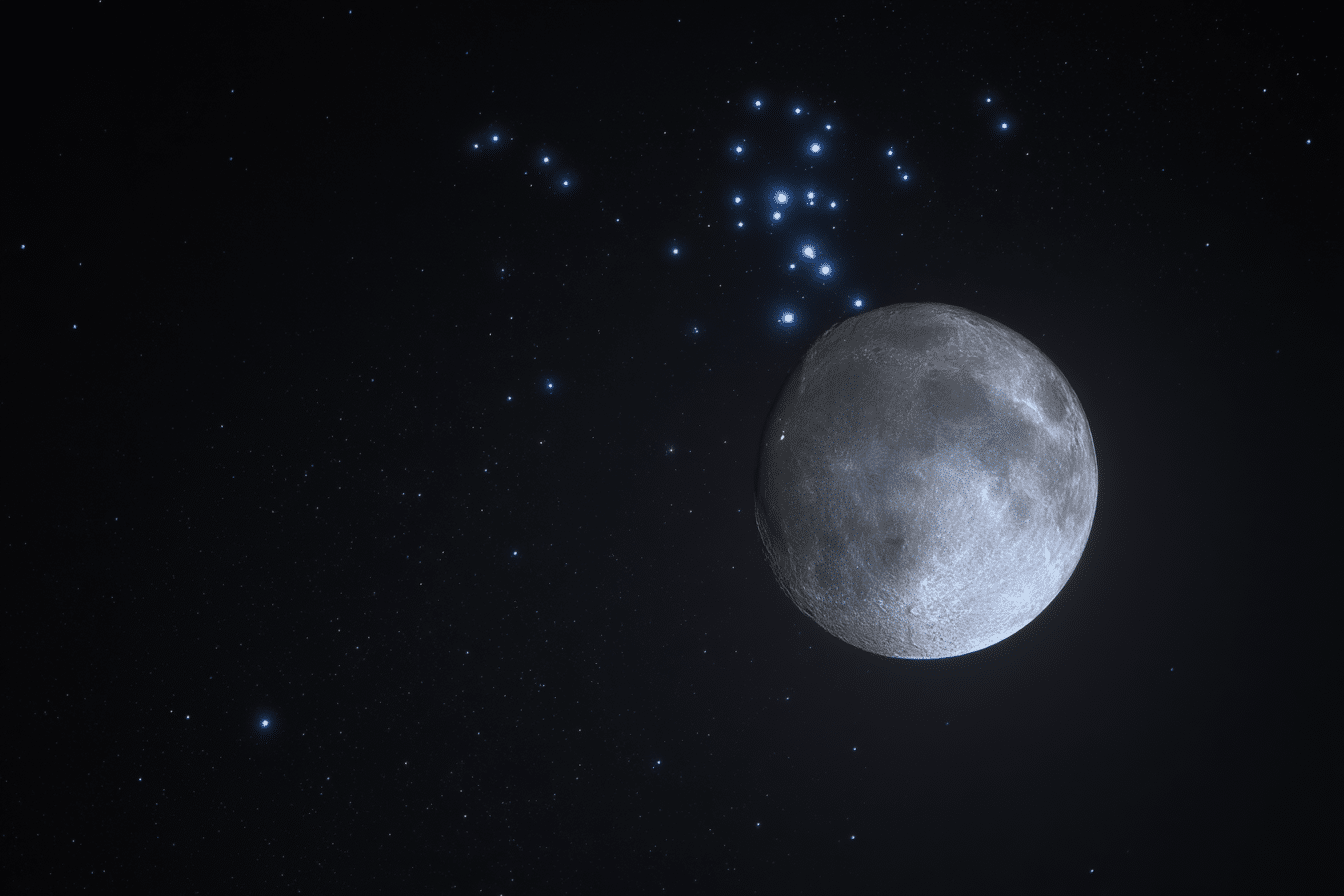
The Moon orbits Earth once a month, tracing an apparent path among the constellations along the zodiac. The Pleiades live inside Taurus, close to that path. So once every lunar month, the Moon brushes past the cluster. Most months it simply passes nearby, as it will on November 6. At other times, the alignment is tighter and the Moon briefly hides one or more of the cluster’s stars from view; that’s called a lunar occultation. Occultations are location-dependent: some regions see them, others don’t—because the Moon’s position against the distant stars shifts slightly across Earth’s surface.
For casual skywatchers, a close pass is already more than enough: the contrast of scale and texture is beautiful on its own. The Moon looks soft and round; the Pleiades look crisp and tiny. Together they tell a story of distance our neighbor next door strolling by a glittering city far, far away.
Where and when to look from your location
You can watch this event from anywhere under a clear sky. Exact times vary by latitude and longitude, but this simple plan works for most places:
- Dusk: Step outside shortly after sunset. Look east for the Moon rising. It will be low and warmly colored at first.
- Evening: As the Moon climbs, scan up and to one side for a tight sprinkle of blue-white stars. That’s the Pleiades. Depending on your location, they’ll appear quite close.
- Midnight: Around local midnight, the Moon and cluster are high in the south, giving their sharpest view without atmospheric haze.
- Pre-dawn: By early morning, they’ll drift toward the west, getting lower and more atmospheric again.
Tip: A simple weather app will list “moonrise” for your city. Plan to be outside 15 minutes before that time to catch the most dramatic, colorful moonrise and the best phone photos.
See more with binoculars and small scopes
- Binoculars (8×40 or 10×50): The best way to enjoy this event. The Pleiades explode into dozens of pinpoint stars, and the Moon’s craters along the terminator look etched with light. Sweep slowly so your eyes can adapt.
- Small telescope (60–100 mm): Use low power. High magnification will kick the Pleiades out of the field of view; the beauty here is the wide frame with both the Moon’s disc and the cluster in the same neighborhood.
- No gear? No problem: The naked-eye view is still magnificent, especially at a dark site where the Seven Sisters sparkle.
Simple phone photography tips
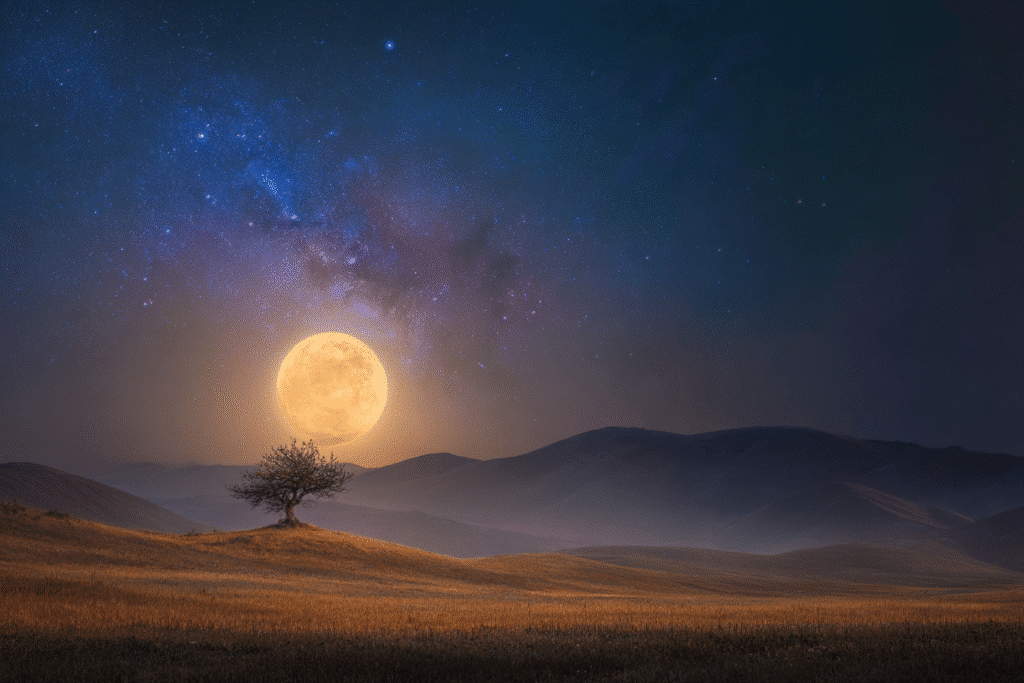
- Shoot near moonrise or moonset when the Moon is low and amber; the dynamic range is easier and the scale against landscapes is dramatic.
- Anchor the frame with foreground: a tree, barn roofline, or mountain ridge.
- Tap to focus on the Moon, then drag exposure down slightly so you don’t blow out the highlights.
- Stabilize: Rest your phone on a railing or use a mini-tripod.
- Try a timelapse: Start at moonrise as the Moon slides toward the Pleiades and let it run for 10–15 minutes.
What you’re actually looking at
- The Moon: 384,000 km away on average, reflecting sunlight from a dusty, cratered surface.
- The Pleiades: A young open cluster about 440 light-years away. The seven brightest stars are famous, but binoculars reveal many more. Long-exposure photos show delicate blue reflection nebulae surrounding the stars; your eyes won’t see that nebulosity, but you can feel the “frosted” sparkle.
The mind loves these numbers because they give scale. The heart loves the view because it softens the scale into beauty.
A mindful sky ritual aligned with the Seven Sisters
MedTastes lives at the intersection of awareness and wonder. Here’s a simple, human ritual you can do under the Moon–Pleiades pairing to support spiritual awakening in everyday life.
Arrival
- Put your phone on Do Not Disturb.
- Place one hand on your heart, one on your belly.
- Inhale for 4, hold for 4, exhale for 6. Repeat five cycles. Feel your system settle.
Seeing
- Look first at the Moon. Name one thing you’re ready to release.
- Shift your gaze to the Pleiades. Name one quality you’re ready to grow—clarity, compassion, courage, devotion, creativity, discipline, or presence.
Bridging
- Close your eyes and imagine a silver thread between the Moon and the Seven Sisters. With the next exhale, imagine your release traveling toward the Moon. With the next inhale, imagine the chosen quality streaming back from the Pleiades into your chest.
Integration
- Whisper a one-line intention: “I release what is complete. I cultivate what is true.”
- Take one small, real action within 24 hours that proves it—a message you’ve avoided, a five-minute declutter, a micro-workout, a page in your journal, a kind apology.
Awakening is a practice, not a pose. Small proof beats big talk.
Spiritual meaning across cultures and how to make it personal
The Pleiades appear in myths worldwide: Greek, Japanese (Subaru), Māori, Maya, and many more often tied to seasonal turning points, planting, navigation, and the return of light. The Moon symbolizes cycles, memory, and the hidden made visible. When they meet, a few themes naturally arise:
- Transition with guidance: The Moon’s monthly journey past the Seven Sisters hints at a guided crossing. Where are you moving from and to?
- Remembering the original self: The Pleiades’ youthful stars carry a feeling of beginnings. Pair that with the Moon’s wisdom of cycles and you get renewal that honors experience.
- From reaction to response: The bright Moon can wash out faint stars. Awareness practice is learning to quiet inner glare so subtle guidance becomes visible again.
If you’re walking the path of spiritual awakening, let this sky night be a checkpoint: soften self-judgment, step out of conflict thinking, and realign with choices that match your values.
Family and community ideas
- Invite friends for a “Seven Sisters circle.” Everyone shares one thing they’re releasing and one quality they’re inviting. Keep it under a sky blanket with tea.
- With kids, search for the “tiny dipper,” count how many stars each person can see, and draw the cluster afterward from memory.
- Try a screen-free hour. The sky is a powerful reset.
Occultations: when the Moon actually hides a Sister
Sometimes the geometry is so tight that the Moon passes in front of one or more Pleiades stars, making them wink out and back in along the lunar limb. These events are rare for a single spot on Earth but occur in worldwide series that run for months to years. We are currently in such a series, continuing into mid-2029. If one lines up for your region, it’s worth setting an alarm: a bright star disappearing against the Moon’s dark edge is pure magic.
Planning beyond November 6
The Moon passes Taurus every month, so you’ll get more chances to enjoy this pairing. Some recent and near-term “close passes” in 2025 include mid-August, mid-September, early October, and early December, with a North America–friendly occultation in early December. Keep an eye on your local sky calendar for the next dates in your time zone.
Awareness prompts you can journal under the Moon–Pleiades sky
- Where has my energy scattered this month, and what single boundary would bring it home?
- Which Seven Sisters quality do I most need right now: clarity, compassion, courage, creativity, constancy, curiosity, or calm?
- If the Moon represents release, what habit is ready to be retired with gratitude?
- If the Pleiades represent guidance, what gentle signal have I been ignoring?
Practical tips to make your night easy and memorable
- Scout your horizon: Choose a spot with a clear view east for moonrise or south for peak height.
- Mind the light: Even one streetlamp can wash out the Seven Sisters. A park, field, or rooftop helps.
- Dress warm: Even mild nights can chill when you stand still under the stars.
- Bring simple gear: A blanket, thermos, binoculars if you have them, and a notebook.
- Stay present: Take your photo, then put the phone away. Savor two unbroken minutes of simply looking.
How this fits our larger theme of awareness and spiritual awakening
Events like the Moon meeting the Pleiades are invitations to practice. Awareness is not an abstract state; it’s how you breathe, choose, speak, and spend attention. Sky nights make practice easier because they naturally slow the mind and widen perspective. They also whisper a practical truth: cycles bring second chances. If you missed a boundary, a habit, or a promise to yourself last month, the Moon will be back beside the Seven Sisters in about four weeks. Try again. That rhythm is grace.
FAQs
What exactly will I see on November 6, 2025?
A bright waning gibbous Moon drifting close to the compact Pleiades cluster in Taurus. To the eye it looks like a glowing coin beside a tiny dipper of blue-white stars.
Do I need a telescope?
No. The naked-eye view is beautiful. Binoculars make it exceptional by resolving many more cluster stars and sharpening lunar detail.
What time should I look?
Start after dusk and watch through the evening. The Moon and Pleiades rise in the east after sunset, are highest around midnight, and head west before dawn. Check your local moonrise time for the perfect start.
Why do the stars look blue?
The Pleiades are young, hot stars that emit more blue light. In photos you’ll also see blue reflection nebulae, but to the eye it’s the “icy” sparkle that stands out.
Can the Moon actually hide the Pleiades?
Yes. During certain months and locations, a lunar occultation occurs where the Moon covers one or more Pleiades stars. These events are part of a global series continuing into 2029, but visibility depends on where you are.
A closing invitation
On November 6, step outside. Find the Moon. Let your eyes adjust until the Seven Sisters appear, a little swarm of frost beside silver light. Breathe. Release one small thing that’s complete. Invite one true quality for the month ahead. Then carry that intention back indoors and put it to work in one action before you sleep.
The universe doesn’t just speak in thunder; it speaks in small, repeating rhythms—the Moon’s monthly walk past a handful of bright, young stars. Meet it there, and let awareness do what it always does when we finally look up: soften the noise, steady the heart, and open the way forward.