
Table of Contents
Why the Taurids Captivate: Slow, Golden, and Unforgettable
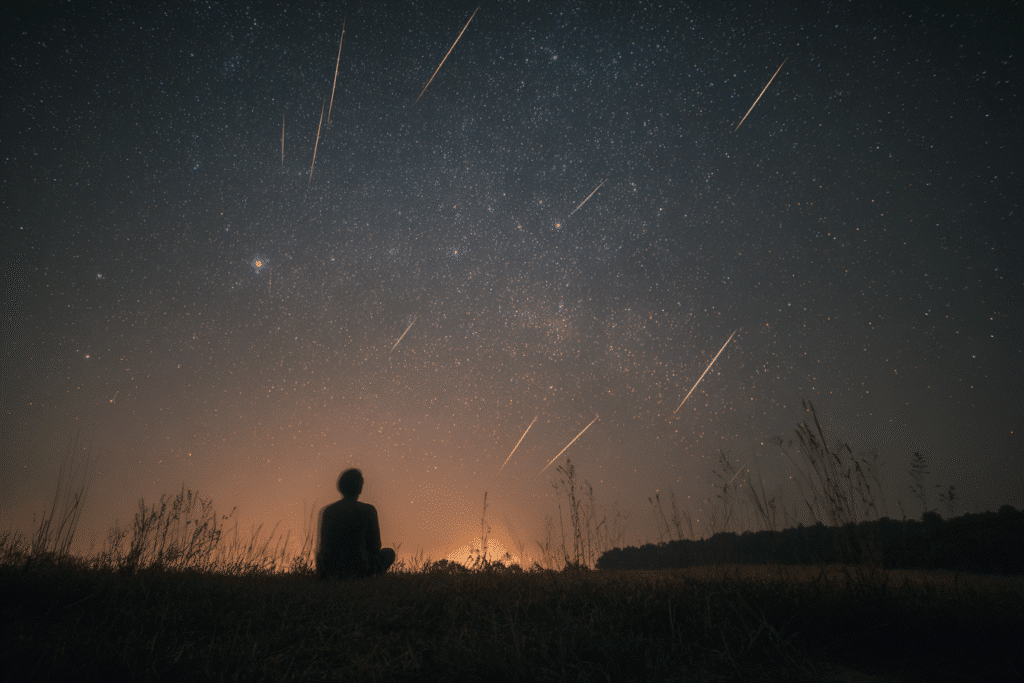
The Taurids are not a “meteor storm.” They are a mood. These meteors drift rather than dart, often glowing with long, golden trails that seem to hang in the air. That lingering brilliance is why skywatchers love them and photographers plan for them. In early November each year, Earth plows through two debris streams: the Southern Taurids first, then the Northern Taurids about a week later. In 2025, the Southern Taurids crested around November 4–5, and the Northern Taurids take center stage around November 12, with a broad window of activity all month.
Under a dark sky, typical rates are modest, several meteors per hour, but the payoff is the “fireball personality.” Even one bright Taurid can light up your entire horizon for a heartbeat, casting shadows and drawing gasps. Think “quality over quantity.”
When to Watch: Focus on November 12 (and the Nights Around It)
The Northern Taurids’ broad maximum means you don’t need a single-night bullseye. Your highest odds cluster around November 8–12, with special attention to the night of November 12. The shower is best after local midnight, when its radiant in Taurus climbs high and the geometry favors longer, brighter trails.
Region-by-region timing
- North and South America: Start around 11 p.m. local time; the radiant is well placed by midnight through dawn.
- Europe and Africa: Begin near 11 p.m. local time; stay out past 01:00 for the most graceful, lingering fireballs.
- Asia and Oceania: Aim for midnight to pre-dawn; Taurids pair beautifully with the Pleiades and Aldebaran high in the sky.
Where to Look: Find Taurus, Aldebaran, and the Pleiades
Face east in the evening, then south after midnight as Taurus arcs across the sky. The radiant sits near the face of the Bull, not far from Aldebaran (an orange giant) and the Pleiades (M45), a tiny blue-white “dipper.” You don’t need to stare at the radiant. In fact, meteors that appear 30–60 degrees away often show longer, more photogenic trails.
Naked eye first, optics second
Meteor showers are a naked-eye sport. Wide vision catches more sky. Binoculars and telescopes are beautiful for the Pleiades, Aldebaran, and the Moon’s craters, but they narrow your field and can make you miss meteors. Scan slowly, keep your posture comfortable, and let the sky do the work.
Moonlight Reality Check (and How to Beat It)
On November 9, the Moon is waning from the early November supermoon, so skyglow will be noticeable, especially before moonset. Moonlight reduces the number of faint meteors you’ll see, but it does not erase bright Taurid fireballs.
Moon-smart strategies
- Block the glare: Put a building, tree line, hill, or car roof between you and the Moon.
- Chase shadows: Position yourself so the Moon is behind you; look 60–120 degrees away from it for best contrast.
- Use topography: Valleys and eastern-facing slopes can shield your view as the Moon sinks lower.
- Stay longer: With a broad peak and slow trails, your chances improve with time on the field.
Spiritual Layer: Awareness under Firelight
Your site speaks to awareness and spiritual awakening, so fold this sky moment into practice. Meteor watching is a living meditation. open, patient, present.
A simple night ritual
- Set the tone: Two minutes of slow breathing. Hands to heart. Intention: “I choose awareness, clarity, and gentleness tonight.”
- Ground the body: Bare feet on earth if it’s safe and warm enough, or touch the ground with a palm.
- Soft gaze: Unfocus a little to invite the periphery; notice what you hear, smell, and feel.
- Meaning in motion: When a Taurid appears, label the feeling rather than the story: awe, warmth, gratitude. Let it pass.
- Close in gratitude: One sentence aloud: “For this night and this breath, thank you.”
Symbolism you can share with readers
- Slow meteors, steady growth: Not everything bright must be fast.
- Fireballs, inner ignition: One spark can change a night, or a life path.
- Taurus, embodiment: Breath and body wisdom. awareness anchored in the present.
How to Prepare: A Practical Checklist
Seeing more meteors is mostly about comfort and patience. The longer you’re outside, the more you’ll catch.
Gear and comfort
- Seating: A reclining camp chair or yoga mat with a pillow to keep your neck relaxed.
- Warm layers: Hat, scarf, gloves; pack more than you think you need. Cold shortens sessions.
- Hot drink + snacks: Warmth keeps you outside through the best hours.
- Red-light headlamp: Preserves night vision. Avoid white/blue phone light.
- Apps offline: Download a star chart app but keep the screen dim and rare.
- Companions: Meteor nights are better with someone to share the wow.
Site selection
- Darkness first: Every step away from city lights adds more stars and more meteors.
- Horizon: Choose a site with an open southern sky after midnight.
- Safety: Tell someone your plan; bring a charged phone, but keep it in airplane mode to protect night vision and presence.
City strategies if you can’t travel
- Use a rooftop or park with tall buildings or trees to block direct lights.
- Let your eyes adapt for 20–30 minutes; avoid screens.
- Look higher in the sky, away from streetlamps and the Moon.
Photography Guide: From Phones to Pro Rigs
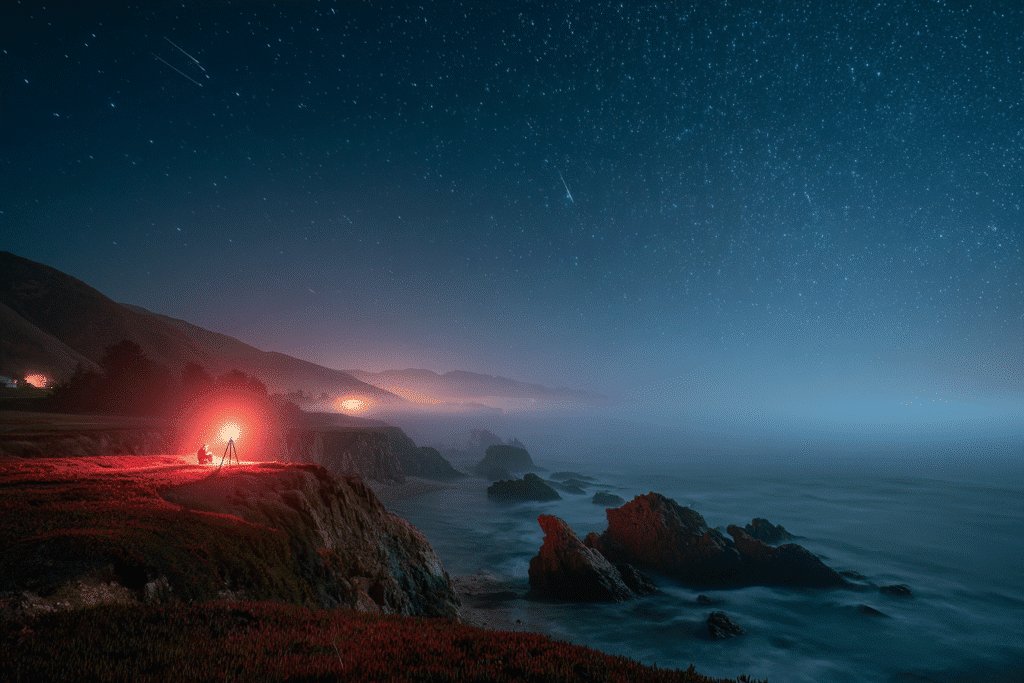
Taurids reward patience and wide fields. Even with moonlight, you can capture dramatic trails—especially the brighter fireballs.
Camera settings for interchangeable-lens cameras
- Lens: Ultra-wide 14–24 mm or wide 20–35 mm to cover more sky.
- Aperture: f/1.4–f/2.8 if available; f/3.5–f/4 works with higher ISO.
- ISO: 1600–6400 depending on sky brightness; test a few frames and adjust.
- Shutter: 10–20 seconds with a wide lens; keep stars sharp (500 rule: 500 ÷ focal length).
- Focus: Manual. Pre-focus at infinity on a bright star or distant light; tape the ring.
- White balance: 3800–4500K for a natural night tone; shoot RAW for flexibility.
- Intervalometer: Fire continuous frames for at least 30–60 minutes; meteors are unpredictable.
- Composition: Include a silhouette—tree, barn, dunes—to give scale. Keep the radiant off-center for longer trails.
Fireball-catching tactics
- Overlap fields: If you have two cameras, aim them 45–60 degrees apart to cover more sky.
- Meteor-safe exposure: Slightly shorter shutter reduces star trailing and keeps meteor cores crisp.
- Shoot through moonset: As the Moon lowers, contrast improves; your rate of keepers often jumps.
Smartphone tips
- Use Night mode or Pro/Manual: Lower the shutter to 10–15 seconds if your app allows; set ISO 1600–3200.
- Stabilize: Mini tripod or bean bag on a car hood; use a 3–10 second timer.
- Wider is better: Clip-on wide adapters help; avoid digital zoom.
- Burst the sky: Some phones offer interval shooting via third-party apps. perfect for meteor time-lapses.
- Post-processing: Gentle noise reduction and contrast; do not over-sharpen.
What Makes the Taurids Different
The Taurid complex has an ancient origin story. Astronomers link the streams to a disintegrated progenitor whose fragments now include Comet 2P/Encke and other small bodies. The Southern Taurids are dominated by Encke debris; the Northern Taurids correlate strongly with a body cataloged as 2004 TG10. Larger meteoroids in these streams explain the shower’s famous fireballs, sometimes bright enough to rival Venus and occasionally producing fragmenting bolides.
If you want a single reference for dates and camera-friendly tips, see this concise guide from EarthSky (one external resource, as requested): EarthSky’s Taurids overview.
Mindful Nightwatch: Turn the Sky into a Practice
Tie your viewing to inner work and your audience will return for more than pictures. Here’s a simple flow you can share:
Before you go
- Clarify the why: One sentence in a notes app or journal: “Tonight I’m practicing patience and presence.”
- Pack a small offering: A trash bag to leave the site cleaner than you found it. Stewardship is spiritual.
On site
- Three breaths per minute, for three minutes: Slow the system. Inhale 4, hold 2, exhale 6, hold 2.
- Name and notice: When thoughts arise, label them gently. planning, remembering, judging. and return to the sky.
- Gratitude on cue: Every meteor, even faint ones, triggers a soft “thank you.”
After
- Integration note (one line): “I felt… I learned… I choose…”
- Share selectively: Post one authentic image or reflection; save the rest for your deeper work.
Troubleshooting: If You’re Not Seeing Much
Meteor watching can test patience. Here is how to keep the night moving in your favor.
Common issues and quick fixes
- Moon too bright: Move so the Moon sits behind an obstruction; look 90 degrees away. Wait for it to sink.
- Clouds rolling in: If they’re thin, stay. fireballs punch through broken cloud. Otherwise, check a nearby microclimate; even 20–40 km can change your sky.
- Too many lights: Shift your position to block a specific glare source. Even a parked car or backpack can help shield lens and eyes.
- Cold fatigue: Warm layers, warm drink, and micro-movements (squats, shoulder circles) buy you another hour, the hour when your best meteor may arrive.
Safety, Etiquette, and Accessibility
- Roadside pullouts: Park fully off-road; use hazard lights while arriving and leaving, not during viewing.
- Wildlife and neighbors: Keep sound low, red lights only, and leave no trace.
- Accessibility ideas: A reclining chair and a thermos turn this into a mindful experience for all ages. For kids, set a “three meteors” goal and celebrate each one.
Content Ideas You Can Publish Quickly
If you’re maintaining a sky-and-awareness editorial calendar, the Northern Taurids are perfect for short, evergreen posts:
- “Northern Taurids tonight: a 10-minute moon-smart guide.”
- “How to photograph slow fireballs with your phone.”
- “Awareness practice under November meteors: breathe, notice, release.”
- “Taurus season in the sky: what a ‘slow meteor’ teaches about steady growth.”
Quick FAQ for Readers
What is the biggest meteor shower in 2025?
The Geminids are expected to be the biggest meteor shower of 2025 in terms of hourly rates. They typically peak around December 13–14 and can produce dozens of meteors per hour under dark skies. The Perseids in mid-August are also strong most years, but for sheer counts the Geminids usually lead.
When to see Taurids?
The Taurids come in two branches with a broad viewing window in early November:
Southern Taurids: roughly late October to early November, peaking around November 4–5.
Northern Taurids: early to mid-November, with the best nights around November 9–12.
Look after midnight when Taurus is highest, face generally toward Taurus/Aldebaran and give your eyes 20 minutes to adapt. Expect fewer meteors per hour, but slower and brighter “fireballs.”
What phenomenon is happening in 2025?
In November 2025, the notable sky phenomenon is the Taurid complex lighting up the season with slow, bright fireballs from two streams: the Southern Taurids first, followed by the Northern Taurids a few days later. Their broad peak window makes them ideal for relaxed viewing and astrophotography sessions across multiple nights.
Are we in danger from the Taurid meteor?
No. Taurid meteoroids are generally small and burn up high in the atmosphere, creating those bright fireballs without reaching the ground. Larger objects within the wider Taurid complex are monitored by professional surveys; there is no specific hazard expected from the Taurids in 2025. As always, enjoy the show safely under dark skies.
Final Night Plan: Your 90-Minute Northern Taurids Playbook
- Arrive 30 minutes early to settle, block stray lights, and let your eyes adapt.
- Warm-up frames if you’re shooting: focus on a bright star, confirm composition, start an interval.
- Breathe and expand awareness: three minutes of slow breathing, then a soft gaze.
- Watch the eastern-to-southern sky as Taurus climbs. Note Aldebaran and the Pleiades as visual anchors.
- Stay curious, not tense: label meteors out loud—“short,” “long,” “golden,” “fragmenting”—like a game.
- Reset every 20 minutes: stretch, sip, reframe composition, and recommit to presence.
- Close with gratitude: one sentence spoken to the night. Pack out everything you brought.
The sky is ready to spark. If you give it time, the Northern Taurids will give you at least one golden line you will remember long after the night is over. Bring warm layers, a patient heart, and the willingness to be surprised.